Article
Putting Private Credit Concerns in Perspective
In recent months, some market participants have become increasingly focused on the potential for late-cycle risks in the liquid and private credit markets – highlighting several high-profile defaults as potential warning signs. In our view, the granular fundamental data suggests these developments are more reflective of heightened dispersion, rather than widespread market disruption.

Assessing Stress Levels
Defaults are nothing new for lending in the non-investment grade space. The long-term default rate in non-investment grade loans, over multiple decades, is about 3.5%.1 Currently, we are not observing outsized evidence of defaults broadly but rather specific instances and individual losses in portfolios. With benign credit conditions for more than a decade, the average default rate has been low for an extended period of time. As a result, recent news coverage of high-profile defaults may create a false impression that the market is experiencing an inflection point of distress as opposed to a reversion to the mean.
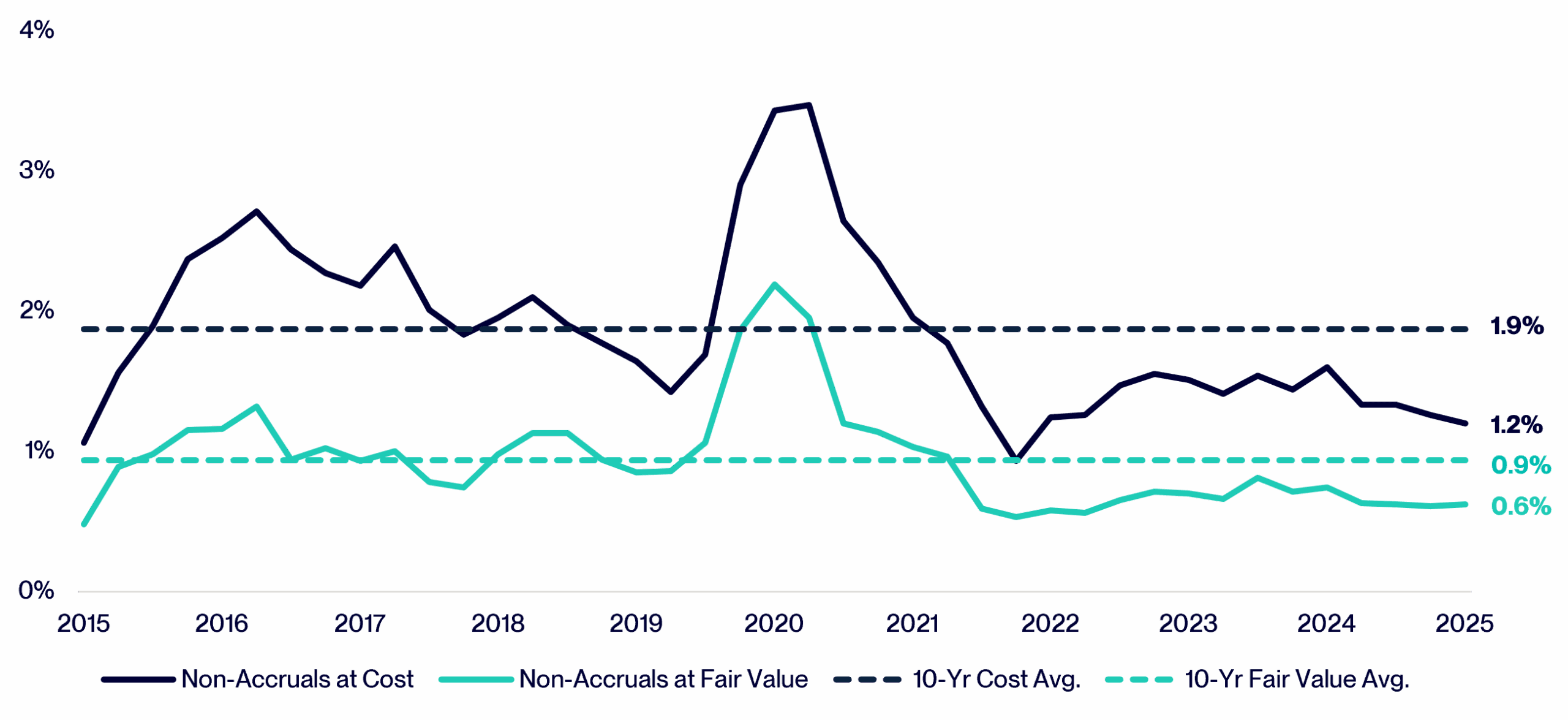
Based on Cliffwater’s data, which tracks nearly 20,000 loans across publicly traded, non-traded and private BDC portfolios, broader portfolio credit performance appears to be generally consistent with or in some cases, better than historical norms. Non-accrual rates, on both a cost and fair-value basis, remain comfortably under the respective 10-year averages and are not upward trending, suggesting credit performance has remained stable.
BDC Non-Accrual Rates2
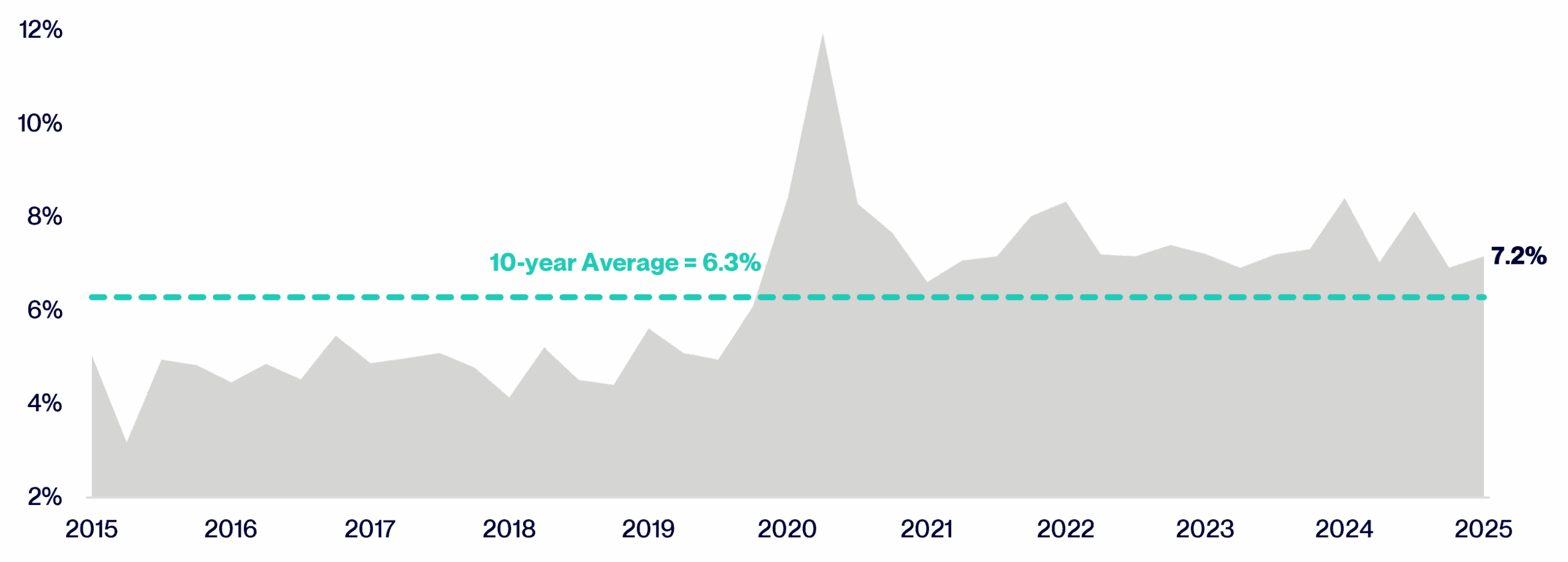
Payment-in-kind (PIK) usage, which some point to as a shadow indication of non-accruals, has increased modestly in recent quarters. However, it remains well below the elevated levels seen in 2020 and below the smaller peaks seen in each of 2022 and early 2024, indicating borrowers have not been increasing their reliance on aggressive forms of flexibility.
BDC PIK Income as Percentage of Total Income2
In our view, it’s important to delineate between ‘good’ and ‘bad’ PIK – the former use case can be a powerful tool when originating new debt that, when implemented thoughtfully, can provide benefits to both borrowers and lenders. In environments where interest rates are elevated or there is a known future catalyst for change in a company’s cash flows, structuring some degree of PIK flexibility up front can help alleviate the pressure of higher cash interest burdens on borrowers and can support a company’s ability to continue to grow. This is what we would typically classify as ‘good’ or intentional PIK.
“Bad PIK” typically refers to PIK terms put in place through an amendment based on a borrower’s request to convert some or all of its cash interest to PIK interest due to underperformance of the business. These situations vary greatly from borrower to borrower, and thoughtful evaluation of each situation is critical. Since PIK interest is added to the principal balance of the investment, it can further exacerbate a capital structure that is already over-levered. Where the underperformance is short-term in nature with a clear path to resolution, temporary PIK relief can be a useful bridging tool for borrowers, helping them avoid a default that may not ultimately be beneficial to investors.
Private Company Fundamentals in Focus
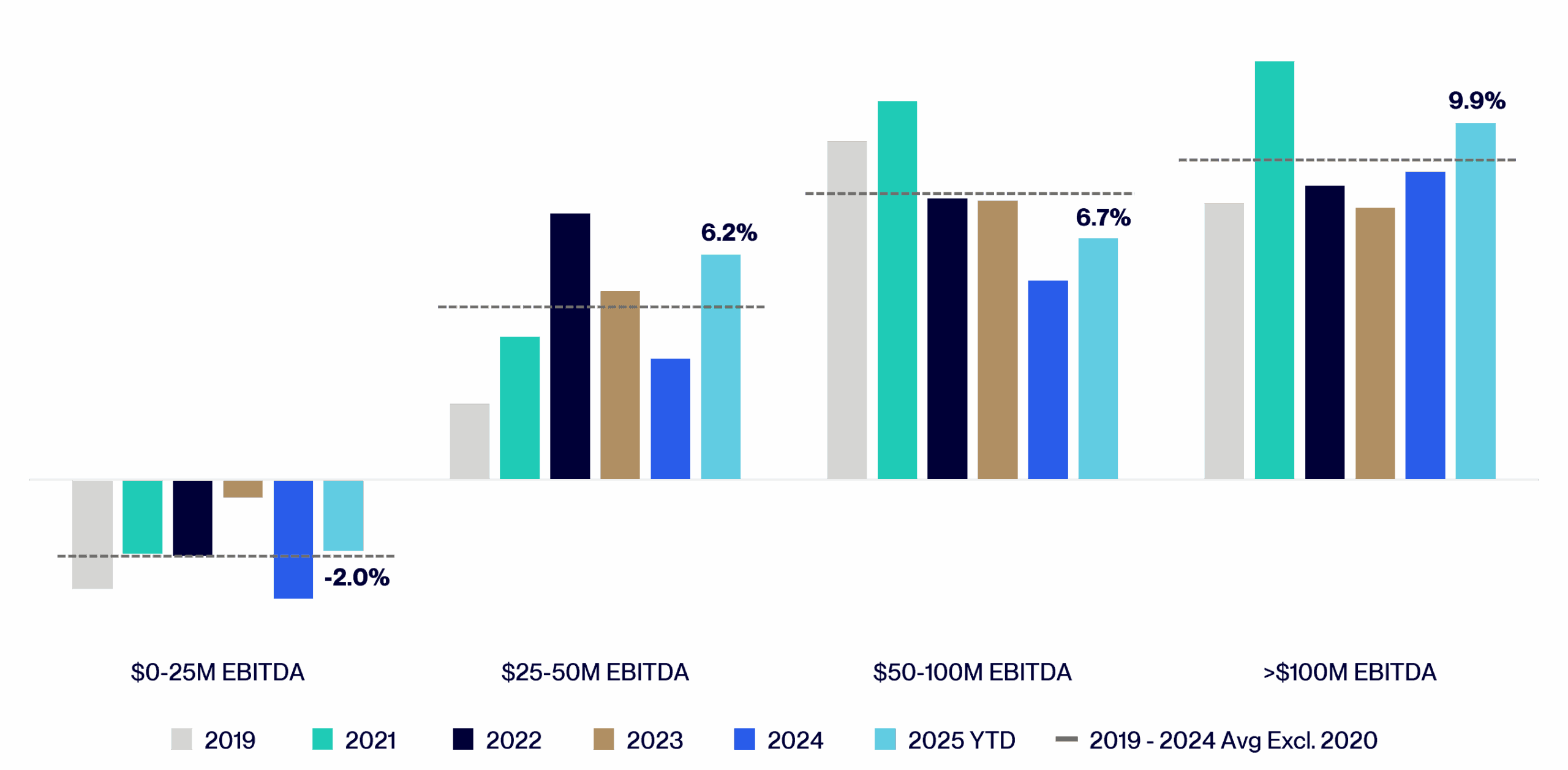
Data from Lincoln International, a prominent independent valuation agent for private credit portfolios, shows that private company fundamentals remain constructive as of the end of the third quarter. All size cohorts showed positive year-over-year trailing 12-month EBITDA growth as of September 30, 2025, except for the smallest borrowers generating less than $25 million of EBITDA.3
Growth is strongest in the upper middle market – companies with $100 million plus of EBITDA – which are posting last twelve months EBITDA growth just under 10%. As shown in the chart at the top of the next page, this is well above their average from 2019 to 2024, excluding 2020 due to the distortive impact of the COVID-19 pandemic. The core middle market – companies with $50 to $100 million of EBITDA – exhibited trailing 12-month EBITDA growth of 6.7% over the same period, demonstrating some resilience even amid a more challenging operating environment.3
Year-Over-Year Last Twelve Months EBITDA Growth Magnitude by Company Size (Based on EBITDA)3
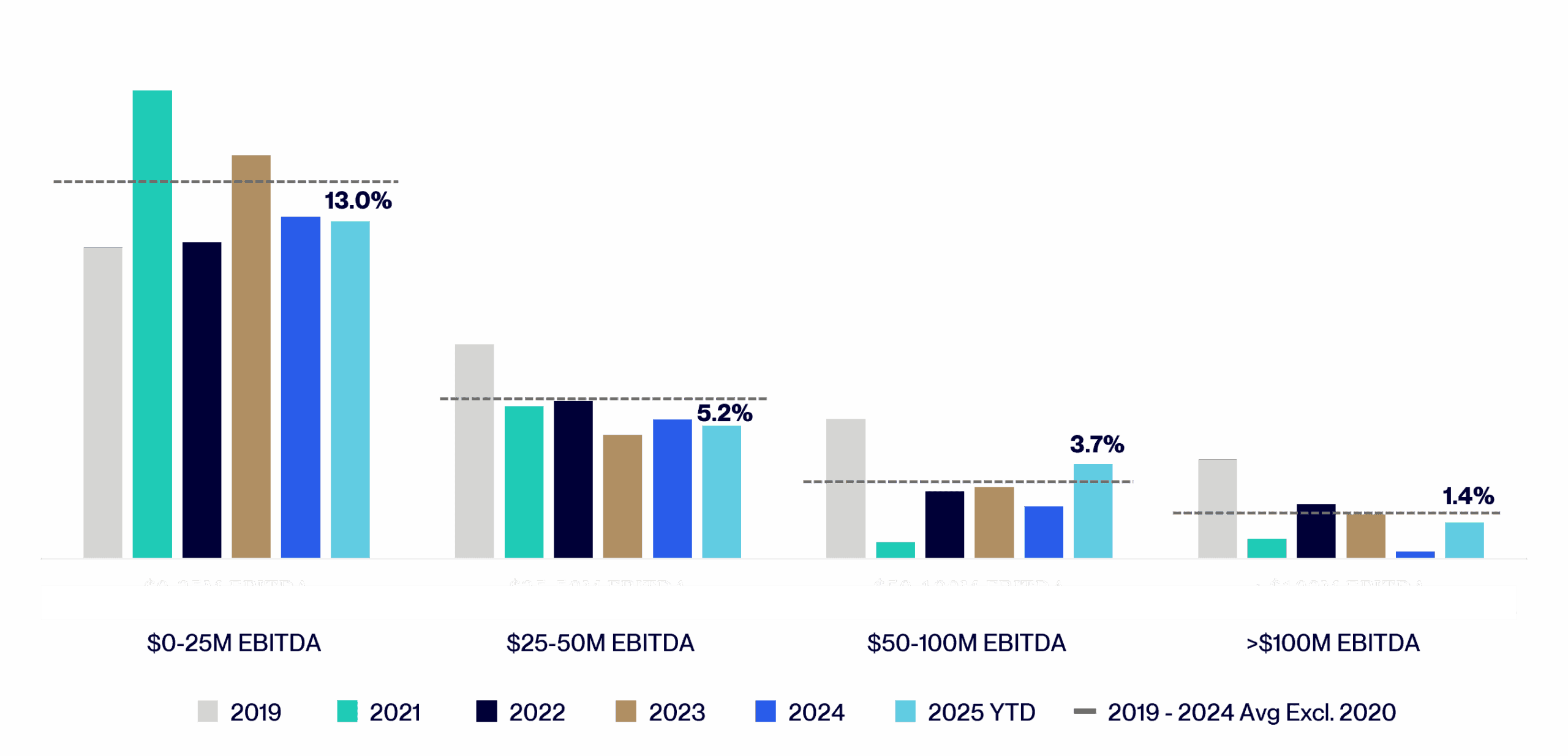
Defaults remain low at the upper end of the market, where companies with $100 million plus of EBITDA show a covenant default rate of just 1.4%, slightly under the 2019 to 2024 average excluding 2020 due to COVID-related default peaks. Defaults are higher in the core middle market but are generally in line with averages over the last five years (excluding the 2020 COVID period), indicating no broad-based stress. We see the most pressure within smaller companies, which we believe have a limited margin for error navigating macroeconomic shocks. Companies with less than $25 million of EBITDA are experiencing meaningfully higher covenant defaults, compared to companies at the upper end of the market, reinforcing our view that experienced private credit managers with scale that invest in larger companies are best positioned during challenging macroeconomic environments.
Private Company Covenant Default Rates by Company Size (Based on EBITDA)3,4
Private Credit’s Growth
The heightened concerns about the health of private credit also have led to questions about the significant growth of the asset class in recent years. In our view, the growth of private credit has been measured rather than excessive, especially when viewed alongside the expansion of private equity – the primary driver of private credit activity.
Over the past 10 years, dry powder in both private credit and private equity has grown at a similar compound annual growth rate – just over 9% – but private credit is doing so off a much lower base.5 Over the same period, private credit dry powder as a percentage of private equity dry powder has remained almost unchanged, underscoring the thesis that the market’s scale remains proportionate to its opportunity set.
Private Credit Vs. Private Equity Dry Powder ($B)5
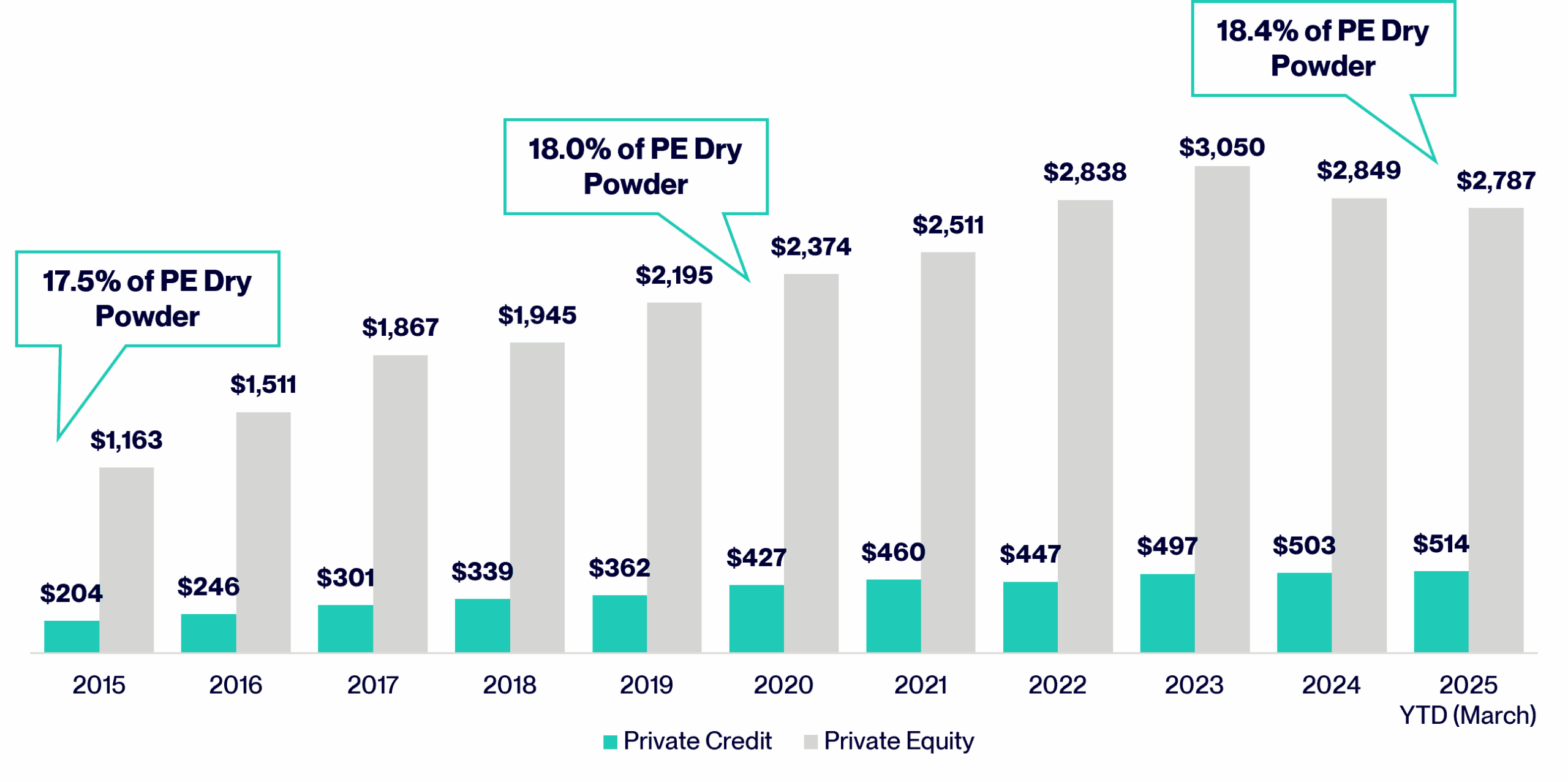
We believe other factors are driving expansion of the addressable private credit opportunity beyond private equity as well. We have observed that companies are staying private longer, expanding the investable universe for direct lenders and supporting long-term demand for private credit solutions. We have also seen that a growing number of larger public companies are increasingly utilizing private credit financing, particularly during periods of market volatility. This has opened a new market opportunity for larger scale providers and, in our opinion, represents one of the largest potential growth vectors for the industry.
Relative Value Proposition
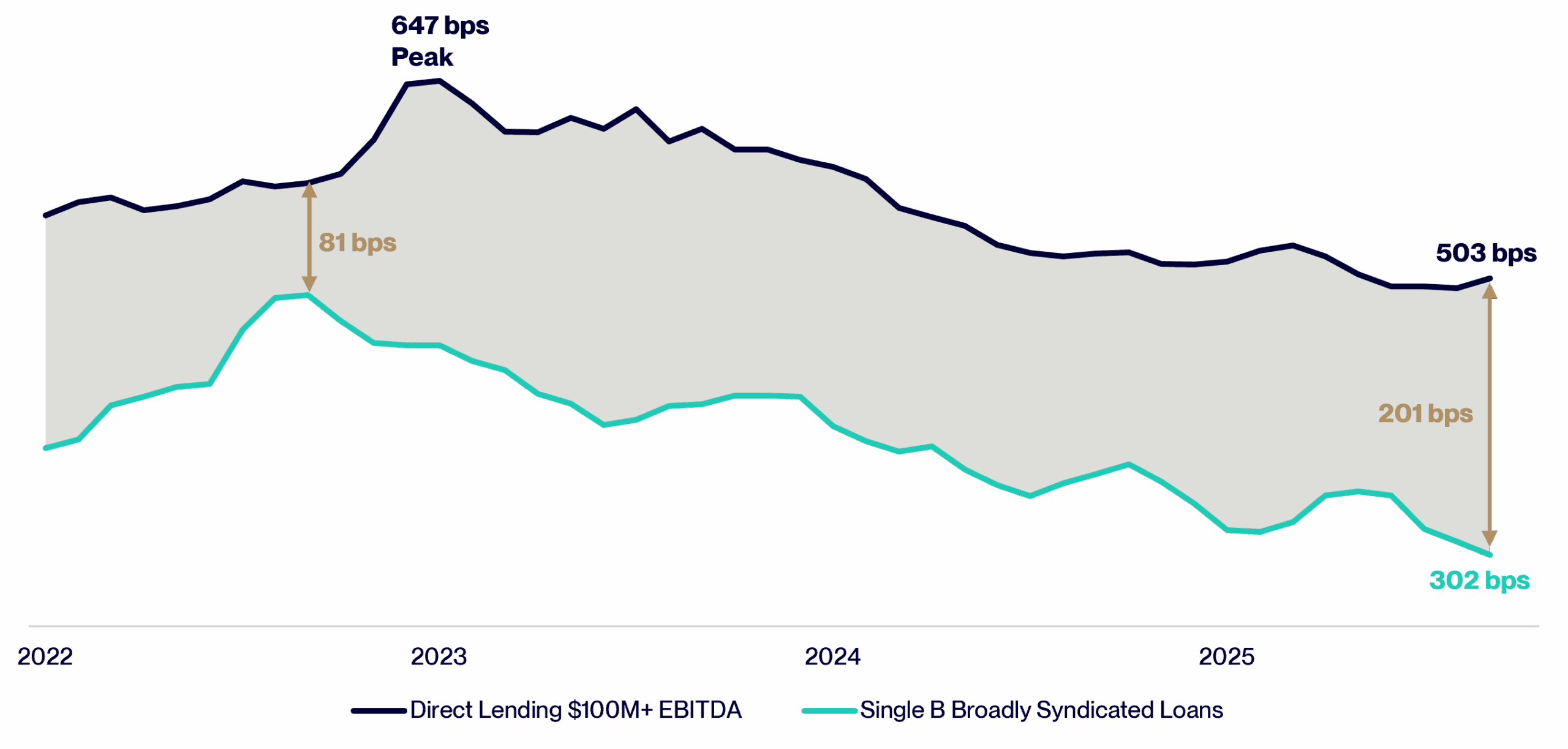
While interest rates have moved lower – with the Federal Reserve cutting five times since September 2024 – and direct lending spreads have compressed from the elevated levels of late 2023, we continue to view all-in private credit returns as attractive. We believe that it is appropriate to evaluate private credit on a relative-value basis, not in isolation. Today, direct lending is offering more than 200 basis points of excess spread return relative to new-issue single-B broadly syndicated loans, the closest comparable public-market floating rate asset class.6 This relative return potential sits at the wider end of the range dating back to 2022, underscoring that relative value remains favorable even as rates and spreads normalize. In short, despite falling base rates and tighter spreads, we feel that the premium investors receive for private credit exposure has remained robust.
Direct Lending Spreads6 vs. Broadly Syndicated Loan Spreads7 (bps)
Conclusion
In our view, we are returning to a credit environment of normalcy following an extended period of subdued defaults. We believe private credit managers that build diversified portfolios with a focus on larger companies are best positioned to mitigate risk.
We remain positive on the private credit opportunity set as it continues to exhibit strong and resilient fundamentals, supporting long-term growth and stability. There is an expanding universe of potential investment opportunities within private credit, driven by increasing demand for non-bank lending solutions. The return profile of private credit remains compelling on a relative value basis, offering competitive yields compared to traditional fixed-income investments. In our view, private credit strategies have the potential to provide compelling risk-adjusted returns compared to traditional fixed income investments through diversification and reduced correlation to public markets.
End Notes
1 Source: Issuer weighted, trailing 12-month default rates for the universe of USD leveraged loan issuers tracked by Moody’s, since inception of the data set (Feb 1996).
2 Source: Cliffwater as of November 1, 2025. Based on the Cliffwater Direct Lending Index (CLDI). The CLDI is an asset-weighted index that measures the performance of private middle-market corporate loans. It is constructed using data from the quarterly U.S. Securities and Exchange Commission (SEC) filings of Business Development Companies (BDCs).
3 Source: Lincoln International – Private Market Perspectives – Quarter Ended September 30, 2025.
4 A default is defined as a covenant default and not a monetary default. The analysis was performed based on a size-weighted approach, which considered the total net debt balance for each of the portfolio companies.
5 Source: Preqin as of November 1, 2025.
6 Source: KBRA DLD as of September 30, 2025. Spread does not reflect the return of direct lending funds, which will be reduced by, among other things, fees and expenses, or the return that may ultimately be realized on an investment. Higher spreads may represent higher cost of capital for borrowers and such costs may increase the risk of default or the risk that the loan may otherwise become impaired.
7 Source: Pitchbook LCD as of September 30, 2025. Both spread levels are calculated on a rolling three-month basis.
Important Disclosures
PAST PERFORMANCE IS NOT NECESSARILY INDICATIVE OF FUTURE RESULTS. The data and information in this material, which has been prepared by HPS Investment Partners, LLC (“HPS”), are presented for informational purposes only. All charts, graphs and images are shown for illustrative purposes only. This material does not constitute an offer to sell or the solicitation of any offer to buy any interest, security, including any interests in any HPS managed funds or accounts, which offer can only be made by definitive offering documentation, which will contain material information with respect to any such interest or security, including risk factors relating to any such investment. All information provided herein is as of the date set forth on the cover page (unless otherwise specified) and is subject to modification, change or supplement in the sole discretion of HPS without notice to you. While this document expresses views as to certain investment opportunities and asset classes, HPS may undertake investment activities on behalf of one or more investment mandates inconsistent with such views subject to the requirements and objectives of the particular mandate. The investments and asset classes mentioned in this document can be highly illiquid, are speculative and may not be suitable for all investors. This document does not provide tailored investment advice and is primarily intended for distribution to institutional investors (as defined under (FINRA Rule 2210(a)(4)). Investing in such investments is only intended for experienced and sophisticated investors who are willing to bear the high economic risks associated with such an investment. Investors should carefully review and consider potential risks as well as their specific investment objectives and experience, time horizon, risk tolerance, and financial situation before making any investment decisions. Nothing contained in these materials constitutes investment, legal, tax or other advice nor is it to be relied on in making an investment or other decision. HPS makes no representation or warranty (express or implied) with respect to the information contained herein (including, without limitation, information obtained from third parties) and expressly disclaims any and all liability based on or relating to the information contained in, or errors or omissions (negligent or otherwise) from, these materials; or based on or relating to the recipient’s use (or the use by any of its affiliates or representatives) of these materials. This document may contain “forward-looking” statements. These are based upon a number of assumptions concerning future conditions that ultimately may prove to be inaccurate. Such forward-looking statements are subject to risks and uncertainties and may be affected by various factors that may cause actual results to differ materially from those in the forward-looking statements. Any forward-looking statements speak only as of the date they are made, and HPS assumes no duty to, and does not undertake to, update forward-looking statements or any other information contained herein. The success or achievement of various results and objectives is dependent upon a multitude of factors, many of which are beyond the control of HPS. The document may not be copied, reproduced, republished, posted, transmitted, distributed, disseminated, disclosed, quoted, or referenced, in whole or in part, to any other person without HPS’s prior written consent. Certain information contained herein, including indices and economic trends is, is based on or is derived from information provided by independent third-party sources. HPS believes that such information is accurate and that the sources from which it has been obtained are reliable; however, it cannot guarantee the accuracy of such information and has not independently verified the accuracy or completeness of such information or the assumptions on which such information is based. Any index information provided herein is included to show the general trend in the applicable markets in the periods indicated and is not intended to imply that the any investment product is similar to any index in composition or element of risk. The indices are not available for actual investment. No index is directly comparable to the investment strategy of any investment product. Moreover, independent third-party sources cited in these materials are not making any representations or warranties and do not guarantee the accuracy, completeness or availability of any information attributed to them and shall have no liability in connection with the use of such information in these materials, including for any errors or omissions (negligent or otherwise), regardless of the cause, or for the results obtained from the use of such content.
General/Loss of capital: An investment in the asset class or in investment vehicles that invest in the asset class described herein involves a high degree of risk. There can be no assurance that investors’ return objectives will be realized, and investors could lose up to the full amount of their invested capital. Limited liquidity: An investment in investment vehicles that invest in the asset class described herein may provide limited liquidity and interests in such vehicles may not be freely transferable or redeemable. There may be no secondary market for interests in such vehicles. Dependence on Manager: The manager of any investment vehicle that invests in the asset class described herein may have total trading authority over such vehicle. Decisions made by such manager may cause investors to incur losses or to miss profit opportunities on which they would otherwise have capitalized. Volatility: Investment techniques used by an investment vehicle that invests in the asset class described herein may include the use of leverage and derivative instruments such as futures, options and short sales, which amplify the possibilities for both profits and losses and may add volatility to such vehicle’s performance. Regulation: An investment vehicle that invests in the asset class described herein may not register as an investment company under the U.S. Investment Company Act of 1940 or similar laws or regulations. Accordingly, the provisions of such laws and regulations would not be applicable.
The foregoing risk factors do not purport to be a complete explanation of the risks involved in an investment in the asset class, or in investment vehicles that invest in the asset class, described herein. Investors in any security should read the entire offering materials of such security before making investment determinations.
Where applicable, this material has been distributed by HPS Securities LLC (“HPS Securities”), an affiliate of HPS and a broker/dealer registered with the U.S. Securities and Exchange Commission and member of the Financial Industry Regulatory Authority (“FINRA”) and the Securities Investor Protection Corporation (www.sipc.org). HPS Securities does not provide research reports.